Austria's power charge from 2027: the highest quarter-hour counts
If your business already pays a power charge (Leistungspreis) for electricity, the grid operator (Netzbetreiber) will bill it month by month from 1 January 2027. The quarter-hour with the highest demand you drew in each calendar month at your main metering point (Hauptzählpunkt) then sets the charge.[1] For households and small businesses without power metering (Leistungsmessung), the peak-based power charge comes later. On network level (Netzebene) 7 E-Control sets the start per network area (Netzbereich). According to a draft amendment of 17 November 2026, it is 1 July 2027 in Carinthia (Kärnten), 1 October 2027 in Salzburg, 1 July 2028 in the Kleinwalsertal and 1 January 2028 in every other network area.[24]
Updated on 19 November 2026: the network level 7 dates per network area from the draft amendment of the SNE-G-V, and the new rule for energy communities.
Updated on 30 October 2026: the 2027 amounts from the SNE-T-V 2027 draft of 29 October 2026, plus E-Control's household figures.
The basis is E-Control's regulation on the principles of grid charges (Systemnutzungsentgelte-Grundsatzverordnung, SNE-G-V), published on 12 October 2026 (BGBl. II Nr. 299/2026). It sets out how grid fees (Netzentgelte) are calculated from 2027. How much a kilowatt costs is set by a separate tariff regulation, the SNE-T-V 2027. So far there is a draft of it dated 29 October 2026; E-Control expects the final text in mid-December.[10] All 2027 amounts in this post come from that draft and may still change.
One quarter-hour per month
Billing is per calendar month, based on the "highest monthly quarter-hour demand value" at the main metering point, the metering point (Zählpunkt) where your installation meets the public grid.[1] If a business draws 50 kWh in one quarter-hour, that equals 200 kW. If the highest quarter-hour in March falls on a Monday at 6:45, because ventilation and production start up at the same time, that value applies to the whole of March. Substitute values (Ersatzwerte) from the grid operator count like measured values.
From 2027 the grid usage charge (Netznutzungsentgelt) consists of a power charge and an energy charge (Arbeitspreis), and according to the regulation the ratio is to be "raised step by step in favour of the power charge".[3] E-Control's explanatory notes name a target of a 50 % power share within three years, across all network levels. On network levels 3 to 6 that value is already reached on average; on network level 7 it is just under 29 %.[4] On network level 7 in particular, the monthly peak will carry more weight in your grid fees.
What changes for businesses with power metering
Until the end of 2026 the power charge is as a rule assessed over a year, as the average of the twelve monthly maxima.[5] Each monthly peak already counts for one twelfth today. From 2027 each month is billed on its own. On network levels 1 to 6 you pay for at least 20 % of your contracted connection capacity (netzwirksame Leistung).[6] A business on network level 6 therefore pays for at least a fifth of its contracted capacity even in a quiet month.
On network level 7 a single price per kW applies at first. Once the transition ends in your network area (dates in the table below), the monthly power charge has two tiers, one price up to 10 kW and a second for the share above.[7][24] From then on a 2 kW floor applies too: if you push your peak below 2 kW, you still pay for 2 kW.[6]
When it reaches households and small businesses
Under the SNE-G-V, connections on network level 7 without power metering first pay a flat fee (Pauschale) per metering point from 1 January 2027; their peak plays no role yet.[7] When the peak-based power charge starts depends on the network area. The SNE-G-V sets a common transition up to 30 November 2027 and allows its end to be changed per network area within 1 January 2027 to 30 June 2028.[2] Based on the grid operators' reports, E-Control put forward a draft amendment on 17 November 2026 with a date for each network area. The dates become binding only once it is published:[24]
| Network area | Peak-based power charge from | Grid operator announcement |
|---|---|---|
| Carinthia | 1 July 2027 | – |
| Salzburg | 1 October 2027 | Salzburg Netz: expected 1 October 2027[17] |
| Burgenland | 1 January 2028 | – |
| Graz | 1 January 2028 | – |
| Innsbruck | 1 January 2028 | IKB: expected 1 January 2028[18] |
| Klagenfurt | 1 January 2028 | – |
| Linz | 1 January 2028 | – |
| Lower Austria (Niederösterreich) | 1 January 2028 | – |
| Upper Austria (Oberösterreich) | 1 January 2028 | Netz Oberösterreich: from January 2028[19] |
| Styria (Steiermark) | 1 January 2028 | Energie Steiermark: 2028, according to APA[20] |
| Tyrol (Tirol) | 1 January 2028 | TINETZ: 1 January 2028[21] |
| Vorarlberg | 1 January 2028 | vorarlberg netz: 1 January 2028, according to APA[22] |
| Vienna (Wien) | 1 January 2028 | Wiener Netze: 1 January 2028[23] |
| Kleinwalsertal | 1 July 2028 | – |
Where a grid operator has named a date, it matches the draft. For the network areas marked "–" we found no announcement by 18 November 2026.
For property managers this means: once the transition applies, two buildings with the same annual consumption can pay different grid fees if one of them has higher monthly peaks, for example from charging stations in the underground car park.
For members of energy communities (Energiegemeinschaften), the draft also changes the peak itself. Their power charge is assessed on what they draw from the grid, reduced by the energy allocated to them from the community in the same quarter-hour. From 2027 the SNE-G-V provides this only for shared generation in one building or on one site.[25] The draft extends the rule to local and regional energy communities, and the 2 kW or 20 % floor applies to them too.[24]
What the draft tariff regulation sets out
The SNE-T-V 2027 draft of 29 October 2026 (R SNE 01/26) is not yet law. For the power charge it sets out:
- The power charge is a monthly rate in cent per kW; until now it was an annual value.[11]
- On network level 7, until the switch-over, a single power charge applies to connections with power metering and a flat fee to those without. After that there are two power charges, up to and above 10 kW. The draft leaves the switch-over date open.[12] The dates per network area come from the SNE-G-V draft amendment (table above).[24] In the Vienna network area the power charge is 663 cent/kW during the transition, then 246 cent/kW up to 10 kW and 369 cent/kW above.
- The metering fee (Messentgelt) is dropped. To compensate, the flat fee for connections without power metering rises from 54 to 82.80 euros a year.[13]
- If you agree flexible withdrawal (flexible Entnahme) with the grid operator, you pay a reduced power charge. If you exceed the agreed fixed capacity band (fixe Leistungszone) during the restricted period, you also pay ten times the power charge on the excess.[14]
- Consumption up to 31 December 2026 is billed under the old rules of the SNE-V 2018, even if the bill comes in 2027.[15]
For households, E-Control gives preliminary figures in its press release of 29 October 2026, each calculated over a full year and compared with 2026. On network level 7 without power metering, at an annual consumption of 3,500 kWh, the grid usage and grid loss charges (Netznutzungs- und Netzverlustentgelt) fall by 3.6 % on the Austrian average during the transition from 1 January 2027, still without a power charge, around 15 euros. In some network areas they rise, most of all in Carinthia, by around 50 euros. After the switch to the power charge, assuming 4 kW of demand, they fall by 5.7 % on average, around 24 euros. The largest rises then are in Innsbruck, around 30 euros, and Graz, around 25 euros.[16] What the rates mean for a given connection depends on its network area and, after the switch, on its monthly peaks.
What the 2026 peaks do
One rule already affects the current year. For connections on network level 7 built or contracted before 1 January 2027, the grid fees are determined by the highest of three values: 10 kW, the connection capacity contracted as of 31 December 2026, or the average of the two highest monthly peaks of calendar year 2026.[8]
The regulation ties the monthly power charge to that month's peak, though.[1] The text of the regulation leaves open whether the reference value (Referenzwert) sets a lower limit on the billed demand, and the SNE-T-V 2027 draft does not answer it either. According to the explanatory notes, the rule is meant to avoid back-billing of the flat connection charge, and the grid operator is to inform you of the value once reliable data is available, at least in the web portal or on the grid invoice.[8]
Every connection has its own peak
The main metering point is a single metering point per energy direction, not a sum over several metering points.[9] If a site has three grid connections, there are three monthly peaks and three power charges.
If you add up the load curves (Lastgänge) of all metering points at a site and take the maximum, you get the site's coincident peak (gleichzeitige Spitze). That figure appears on no grid invoice. For the power charge each metering point counts on its own, and its peak can fall on a different day from the site's.
Where your peaks come from
You can only find a monthly peak in quarter-hour values (Viertelstundenwerte). A monthly invoice for 38,000 kWh says nothing about whether the maximum was 90 kW or 160 kW. Since the ElWG, quarter-hour values are the standard resolution for smart meters. Our guide to the load curve shows how to request a metering point's load curve and find its highest quarter-hours.
Common causes are start-up peaks in the morning, short outliers far above the second-highest quarter-hour, and coincidence on certain days, such as heating and production on cold Mondays. If you lower the highest quarter-hour, the second-highest becomes the new monthly peak. If the peak is 180 kW and the next one 172 kW, smoothing the outlier gains 8 kW. If ten quarter-hours sit between 170 and 180 kW, only changing the pattern behind them helps.
Once a peak is set, it applies to the whole month. You can influence next month, and the same month last year is the best guide to it.
Track your monthly peaks before the grid invoice arrives
Once the metering point's contract holder (Vertragsinhaber) consents, the grid operator delivers the quarter-hour values daily via EDA to energiedaten.at. The Peak Loads report shows the highest quarter-hour demand of every month in kW for each metering point, with consumption and feed-in (Bezug und Einspeisung) shown separately and the year's maximum alongside. You see a new monthly peak the day after it happens, while the month is still running.
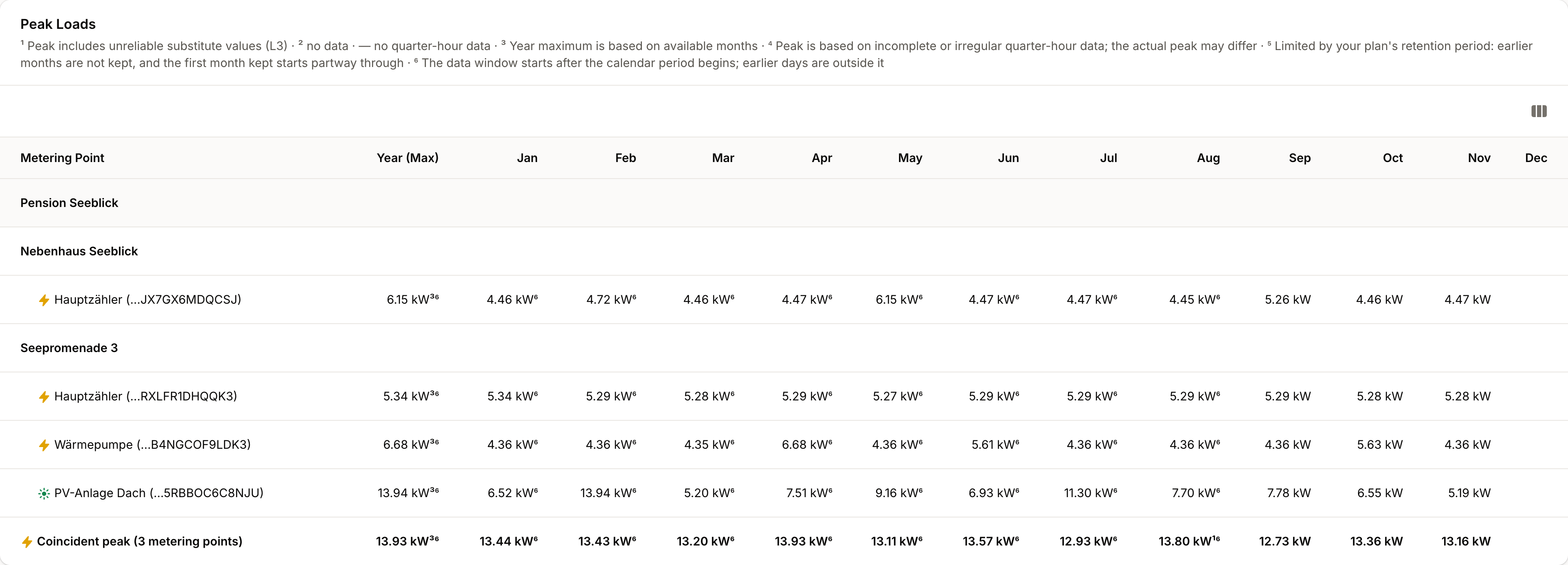
Each row shows the kW maxima of one metering point. The "Coincident peak" row below shows the highest quarter-hour of the combined load of all a customer's consumption metering points, across sites too. It shows how much power a business draws across all its connections at the same time. Gaps and provisional estimates are marked, and the export comes as CSV or XLSX.
The "Power" view of the energy analysis shows exactly when a peak occurred, with the highest quarter-hours and their timestamps. You can see whether a one-off on a Monday morning set the peak or a pattern that repeats every week, and plan next month accordingly.
Both are part of Advanced analysis, included from the Plus plan and bookable as an add-on on the Light plan. Compare the plans or see Peak Loads in a demo.
Frequently asked questions
What will a kW of power cost from 2027?
It depends on the network area and network level, and is final only with the SNE-T-V 2027, expected in mid-December. According to the draft, the Vienna network area on network level 7 has 246 cent per kW and month up to 10 kW after the transition, and 369 cent above.[12]
Should I still lower my peaks in 2026?
The 2027 monthly power charge follows the 2027 monthly peaks. On network level 7, however, the 2026 peaks feed into your connection's reference value. The text of the regulation leaves open whether that value sets a lower limit on the billed demand from 2027.[8]
Where does the power charge appear on my electricity bill?
Under the grid fees. The grid operator bills the power charge as part of the grid usage charge, together with the energy charge.[3] For businesses with power metering it appears there per calendar month from 2027, assessed on that month's highest quarter-hour.[1]
How are grid fees calculated from 2027?
The SNE-G-V sets the method, the SNE-T-V 2027 the amounts per network area and network level.[10] The grid usage charge consists of a power charge and an energy charge, and the power charge's share rises step by step.[3] The grid operator assesses the power charge per calendar month on the highest quarter-hour at the main metering point.[1] On network level 7 without power metering, a flat fee per metering point applies at first, 82.80 euros a year according to the SNE-T-V 2027 draft.[13] The peak-based power charge starts there on 1 January 2028 in most network areas, according to the draft amendment.[24]
[1] SNE-G-V, BGBl. II Nr. 299/2026, § 3(1)–(4): billing per calendar month based on the highest monthly quarter-hour demand value at the main metering point (Hauptzählpunkt); substitute values, calculated values, pro-rating.
[2] SNE-G-V § 6(3b), § 7(4b): the grid operators reported by 11 November 2026, and the change can take place per network area between 1 January 2027 and 30 June 2028. E-Control, explanatory notes on the SNE-G-V (October 2026): "spätestens jedoch mit 1. Juli 2028".
[3] SNE-G-V § 5(1): grid usage charge (Netznutzungsentgelt) made up of power charge (Leistungspreis) and energy charge (Arbeitspreis), raised step by step in favour of the power charge.
[4] E-Control, explanatory notes on § 5 SNE-G-V (October 2026): target 50 % / 50 % within three years; power share on network levels 3–6 at 50 % on average, network level 7 just under 29 %.
[5] ElWOG 2010 § 52(1): power charge based on one year, arithmetic mean of the monthly measured highest quarter-hour demand; repealed at the end of 30 December 2026. SNE-V 2018 § 5: power charge on network level 7 only with power metering.
[6] SNE-G-V § 6(1) and (3): power charge as billing-relevant demand times the monthly rate; minimum assessment basis 20 % (network levels 1–6) or 2 kW (network level 7, very small connections excepted).
[7] SNE-G-V § 6(2) and (3a), § 7(4a): two-tier monthly power charge on network level 7 with the threshold at 10 kW; transition from 1 January to 30 November 2027 with a flat fee per metering point for customers without power metering and a single price per kW for the others; its duration can be changed per network area (§ 6(3b)).
[8] SNE-G-V § 34(1)–(2): reference value for existing network level 7 connections. E-Control, explanatory notes on § 34: avoiding jumps in charges and back-billing, grid operator's duty to inform.
[9] SNE-G-V § 2(1) no. 6: main metering point as the only metering point of the customer installation per energy flow direction, provided it includes no billing points.
[10] E-Control Regulierungskommission, consultation draft of the Systemnutzungsentgelte-Tarife-Verordnung 2027 (SNE-T-V 2027), R SNE 01/26, published 29 October 2026: regulation based on ElWG § 135(2). E-Control, press release of 29 October 2026: consultation until 20 November 2026. E-Control, FAQ Neue Tarifstruktur: adoption and publication in mid-December.
[11] SNE-T-V 2027 draft, § 2(1) no. 4 with explanatory notes: power charge as a monthly rate per kW.
[12] SNE-T-V 2027 draft, § 5(1) no. 6 and § 5(2): network level 7 after the switch (§ 5(1) no. 6) and during the transition (§ 5(2), "abweichend von Abs. 1 … bis zu dem Zeitpunkt XXX"); the switch-over date per network area is left open in the draft ("XXX"). Vienna network area: § 5(1) no. 6 lit. m and § 5(2) no. 1 lit. m.
[13] SNE-T-V 2027 draft, explanatory notes on § 5: annual flat fee of 82.80 euros instead of 54 euros because the metering fee (up to 2.40 euros per month) is dropped, in network areas without the new billing system from 1 January 2027.
[14] SNE-T-V 2027 draft, § 10(1) and (3): reduced power charge for flexible withdrawal (flexible Entnahme); ten times the power charge for exceeding the fixed capacity band during the restricted period.
[15] SNE-T-V 2027 draft, § 17 with explanatory notes: entry into force 1 January 2027, SNE-V 2018 repealed at the same time; consumption up to 31 December 2026 billed under the SNE-V 2018.
[16] E-Control, press release of 29 October 2026, preliminary figures: network level 7 without power metering, 3,500 kWh annual consumption, grid usage and grid losses, Austrian average, compared with the previous year; "alte Systematik" (transition from 1 January 2027, "noch ohne neu eingeführten Leistungspreis") −3.6 % (around 15 euros a year), "neue Systematik" (after the switch, 4 kW of demand assumed) −5.7 % (around 24 euros a year); largest rises: transition Carinthia +50.15 euros (+9.6 %), after the switch Innsbruck +30.04 euros (+6.6 %) and Graz +25.37 euros (+7.4 %); euro amounts include VAT. SNE-T-V 2027 draft, explanatory notes on § 5: cost comparisons refer to full-year billing.
[17] Salzburg Netz, "Neue Stromnetztarife & Leistungspreis", retrieved 18 November 2026: "ab voraussichtlich 1. Oktober 2027" for households and smaller businesses without power metering.
[18] IKB, "Neue Netzentgelte für Strom einfach erklärt", as of October 2026, retrieved 18 November 2026: "voraussichtlich ab 1. Jänner 2028", the exact date is not yet fixed.
[19] Netz Oberösterreich, "Smart Meter" page, retrieved 18 November 2026: demand-based grid charges "die ab Jänner 2028 verrechnet werden" (billed from January 2028). Its SNE-G-V page said on the same day that the date was "aktuell ausgearbeitet" (still being worked out).
[20] APA (Salzburger Nachrichten), 13 October 2026: Energie Steiermark plans the switch for 2028, with no exact day.
[21] TINETZ, "Gut vorbereitet auf das neue Tarifsystem", 12 November 2026, and the information page "Neue Netzentgelte", retrieved 18 November 2026: power charge on network level 7 from 1 January 2028.
[22] APA, 16 November 2026 (published by austria.com): illwerke vkw introduce the model with a power charge in the vorarlberg netz area from 1 January 2028; the date was given in reply to an APA enquiry.
[23] Wiener Netze, "Netzentgelte Neu 2027", retrieved 18 November 2026: all network level 7 customers move to the system with a power charge on 1 January 2028.
[24] E-Control, draft regulation of the Executive Board amending the SNE-G-V (V SNE 02/26), consultation version, officially signed 17 November 2026: § 6(3a) and § 7(4a) with transition periods per network area (Carinthia to 30 June 2027, Salzburg to 30 September 2027, Kleinwalsertal to 30 June 2028, all others to 31 December 2027); § 9(2) for shared energy use under ElWG § 70(6) no. 1 to 4; § 33(3): the transitional rules lapse at the end of 30 June 2028. Explanatory notes: periods based on the grid operators' reports submitted by 11 November 2026; the minimum assessment under § 6(3) also applies to shared energy use.
[25] SNE-G-V, BGBl. II Nr. 299/2026, § 9(2): power charge under shared energy use over shared lines under ElWG § 70(6) no. 1 and 2. ElWG, BGBl. I Nr. 91/2025, § 70(6): no. 1 and 2 shared lines within a building or site (gemeinschaftliche Leitungsanlagen), no. 3 local area (low voltage), no. 4 regional area (medium voltage).
As of 19 November 2026. The 2027 amounts come from the SNE-T-V 2027 consultation draft of 29 October 2026, the network level 7 dates from the draft amendment of the SNE-G-V of 17 November 2026. Neither is final. We will update this post once the final texts are published.
Stay up to date
Get new articles and product updates directly in your inbox.
Related articles
Peer-to-peer electricity in Austria: sharing PV power with your neighbours without an Energiegemeinschaft
Since 1 October 2026 you may sell or give PV power to a neighbour under a contract. Who can take part, what the Netzbetreiber needs, which rule applies when.
Electricity consumption data for CSRD: how ESG teams get audit-ready data
ESRS E1-5 requires measured energy consumption in MWh, disaggregated by source. How ESG teams get the electricity piece from operations in audit-ready form, for every site and grid operator.
ElWG April 2026: dynamic tariffs, SNAP, and new rules
ElWG rules effective 1 April 2026: dynamic electricity tariffs, faster supplier switching, SNAP, and consumer protection. What the second package covers, and what comes next.
EEffG & CSRD: energy data for Austria
The EEffG requires energy audits from around 2,000 Austrian companies, and the CSRD adds sustainability reporting. Which regulations apply and which smart meter data you need for them.
Your smart meter data, daily in your systems
Smart meter data via API, webhook, or CSV for all Austrian grid operators.
Try for free